Planning your crew’s week through a New England winter
Pair outdoor jobs with indoor backups, build in buffer days, time deliveries around storms and short daylight, and keep crew and clients in the loop.
By AGT Work Crew Team

It's Sunday night in January. The forecast says six to ten inches starting Tuesday afternoon, your siding crew is booked on a colonial in Andover, the tile delivery for a bathroom in Quincy is supposed to land Wednesday morning, and it gets dark before 4:30. By Monday at 7 a.m. you'll be on the phone moving people around, again.
You can't control a New England winter. You can plan for it, so the storm costs you a day instead of a week.
Why winter weeks fall apart
Winter scheduling usually breaks for the same few reasons:
- The plan assumes every day is workable. In December through March, some days simply aren't, especially for roofing, siding, decks and exterior paint.
- Exterior and interior work are planned separately, so when the weather turns there's nowhere useful to send the crew.
- Materials arrive on the wrong day. A delivery during a nor'easter either doesn't come or sits in the snow.
- Changes live in someone's head. The owner knows the plan moved. The crew and the homeowner find out when they show up, or don't.
1. Pair every outdoor job with an indoor one
The single most useful winter habit: never schedule exterior work without an interior backup. If the crew can't hang siding in Andover on Tuesday, they should already know where they're going instead: drywall in the Melrose basement, trim in the Quincy bathroom, demo in a gutted kitchen.
When you plan the week, list for each crew:
- The primary job for each day.
- The bad-weather alternative, already confirmed with that homeowner.
- What the alternative needs: materials on site, access arranged, the right tools on the truck.
A backup only works if it's ready. "We'll figure it out" at 6:30 a.m. isn't a backup.
2. Build buffer days into exterior work
Don't book outdoor work back to back across a whole week in January. Leave one buffer day in a stretch of exterior work, and fill it with interior tasks if the weather cooperates. If the storm comes, you have room to slide; if it doesn't, nothing is lost.
Be honest with homeowners about it, too. An exterior job quoted for "about two weeks, weather permitting" in February is easier to deliver than one promised for a fixed Friday.
3. Plan the week early, then re-check daily
Sunday night is too late to plan a winter week. A better rhythm:
- Thursday or Friday: sketch next week, crew by crew, with the indoor alternatives.
- Sunday: check the forecast and adjust the first two or three days.
- Every afternoon: confirm tomorrow. Forecasts for snow and ice change fast along the coast and inland.
Treat the plan for the end of the week as a draft. It's normal to move Thursday on Tuesday.
4. Time materials and deliveries around the weather
Deliveries are where winter quietly costs the most money.
- Ask for deliveries a day before the work, not the morning of. If the truck is late, the crew still has what it needs.
- Avoid deliveries on storm days, and confirm the day before.
- Keep drywall, flooring and cabinets inside, never in the driveway under a tarp. Many products need time to acclimate indoors before installation anyway; check the manufacturer's instructions.
- Plan for the plow. A delivery truck can't reach a driveway that hasn't been cleared, and neither can your crew.
5. Work with short daylight, not against it
In December the sun sets before 4:30 around Boston. Plan exterior work to start as early as practical, and schedule interior tasks for the afternoon. Put inspections, client walkthroughs and deliveries in the late morning, when roads are clear and there's still light.
6. Communicate changes the same way every time
A schedule change only works if everyone hears about it:
- Tell the crew first, the evening before, with the new address and what to bring.
- Tell the homeowner whose job moved, and the one whose job you're moving in, before the crew shows up.
- Update the schedule itself, not just a text thread. If the plan lives in five group chats, nobody knows which version is true.
In winter, the best schedule isn't the one that never changes. It's the one everyone can see when it does.
How AGT Work Crew helps
Scheduling in AGT Work Crew keeps the whole week in one place.
- Create events and tasks that are date-only, timed or span several days, and see them in month or list view.
- Assign workers to each item and link it to the client, property, opportunity or job it's for, so everyone knows exactly where to go.
- Each item is scheduled individually, so moving one day for the weather is simple: change the date on that item.
- Workers see their schedule in the app and update the status as they go.
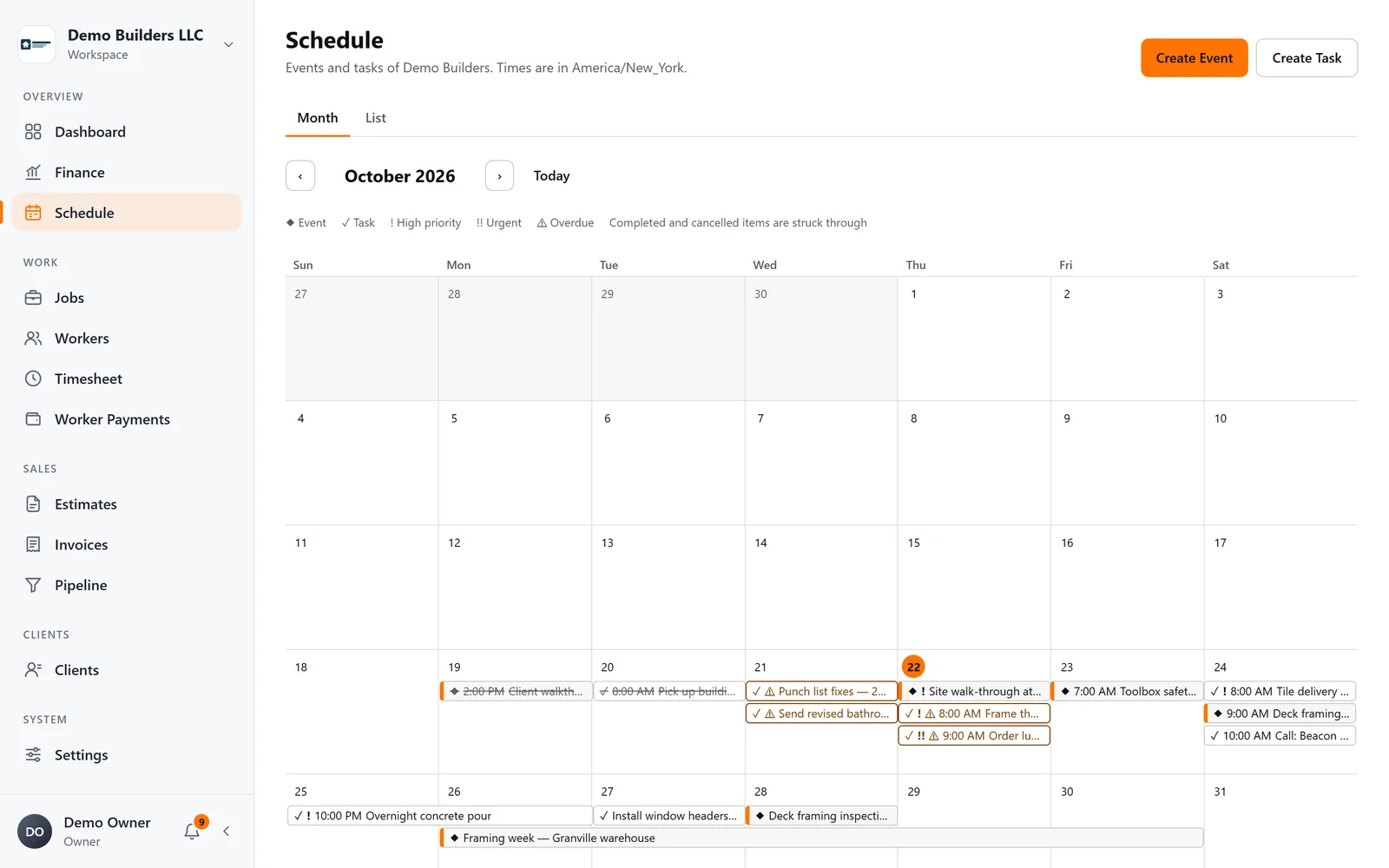
A winter week will always need adjustments. With one shared schedule, they take minutes instead of a morning of phone calls. See how scheduling works.