Running a crew that speaks English, Portuguese and Spanish
Practical ways to give clear instructions, share job and safety info, and onboard new hires when your crew works in three languages.
By AGT Work Crew Team
Monday, 7 a.m., at a gut renovation in Somerville. The foreman explains the plan for the day in English. Two of the guys nod. One of them turns and repeats it in Portuguese to the new hire, and somebody else fills in the Spanish for the tile setter. By ten o'clock, the outlets are on the wrong wall. Nobody was careless. The message just changed a little every time it was passed along.
Crews around Boston, Framingham, Lowell and Providence often work in two or three languages. That's not a problem to fix. It's the reality of a strong local workforce, and the companies that handle it well get better work, fewer mistakes and people who stay.
Language gaps cost more than you think
When instructions don't land, you pay for it in ways that rarely show up as a line item:
- Rework. A cut in the wrong place, a fixture at the wrong height, the wrong grout color. Fixing it costs materials and a day.
- Safety. A warning that one person half-understood is a warning that didn't work.
- Silence. Many workers won't say "I didn't understand" in front of the crew, especially when they're new. They guess instead.
- Turnover. People leave jobs where they always feel one step behind.
1. Make instructions short, specific and visual
The clearer the instruction, the less it depends on language. Before the day starts:
- Say what, where and how much. "Hang drywall in the back bedroom, ceiling first, finish by lunch" survives translation. "Get going on the drywall" doesn't.
- Show it. Point at the plan, mark the wall, take a photo of the detail you want. A picture means the same thing in every language.
- Ask for it back. Instead of "Got it?", ask someone to repeat the task in their own words, in whatever language they're comfortable with. You'll hear the misunderstanding before it becomes rework.
- Write down the numbers. Measurements, heights and quantities belong on paper or in a message, not just in the air.
2. Put written job and safety information in the worker's language
Spoken instructions fade. Written information stays, and it only works if people can read it. Wherever you can, give each worker the key information for the job in a language they read comfortably: the address, the start time, the scope for the day, the site rules and the safety points that matter on that site.
If you don't speak Portuguese or Spanish yourself, start small. A short set of standard notes for the things you repeat on every job (site rules, cleanup, who to call when something goes wrong), translated once and checked by someone you trust, goes a long way.
3. Use team leads as bridges, not as interpreters on call
Most bilingual crews already have someone who naturally connects everyone. Recognize that role instead of taking it for granted:
- Choose leads on purpose. Pick people who are trusted by the crew and who understand both the work and the language.
- Give them the plan first. A lead who heard the plan at 6:45 explains it better than one who heard it at the same time as everyone else.
- Don't make them the only channel. If every message has to go through one person, that person becomes a bottleneck, and nothing gets done when they're out sick.
- Value the extra work. Bridging languages all day is a skill. Treat it like one.
4. One source of truth for schedule and hours
The fastest way to create confusion is to have the schedule in one place, the address in a text thread and the hours on a sheet in the truck. When everyone looks at the same information, in their own language, there's much less to translate and much less to argue about.
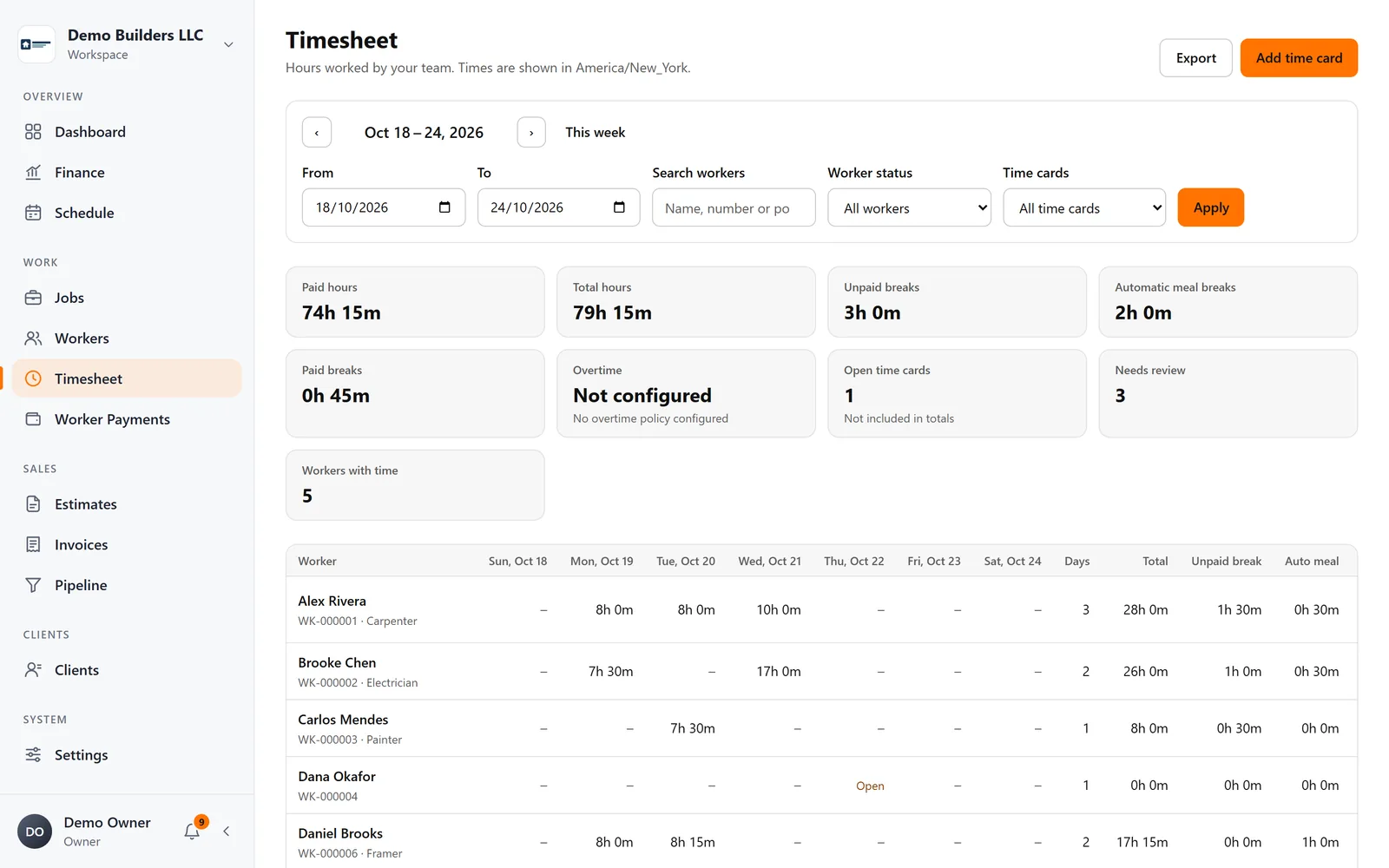
That matters most for two things: where people need to be, and how many hours they worked. If a worker can check the schedule and their own hours at any time, small mistakes get caught on Tuesday, not on payday.
5. Onboard new hires in a way they can follow
The first week decides whether a new worker becomes part of the crew. Make it easy:
- Pair them with someone who speaks their language for the first few days.
- Walk them through the basics in writing: how to start the day, how to record hours and breaks, who to ask for help.
- Get them set up on day one, not after the first payday.
- Check in at the end of the first week. Ask what was unclear. The answers will improve your process for the next hire.
6. Respect is the foundation
None of this works without respect. Speak to people directly, not through others, whenever you can. Don't joke about accents or assume what someone understands based on where they're from. And make it normal to ask questions in any language. A crew that feels respected tells you when something is wrong before it costs you money.
How AGT Work Crew helps
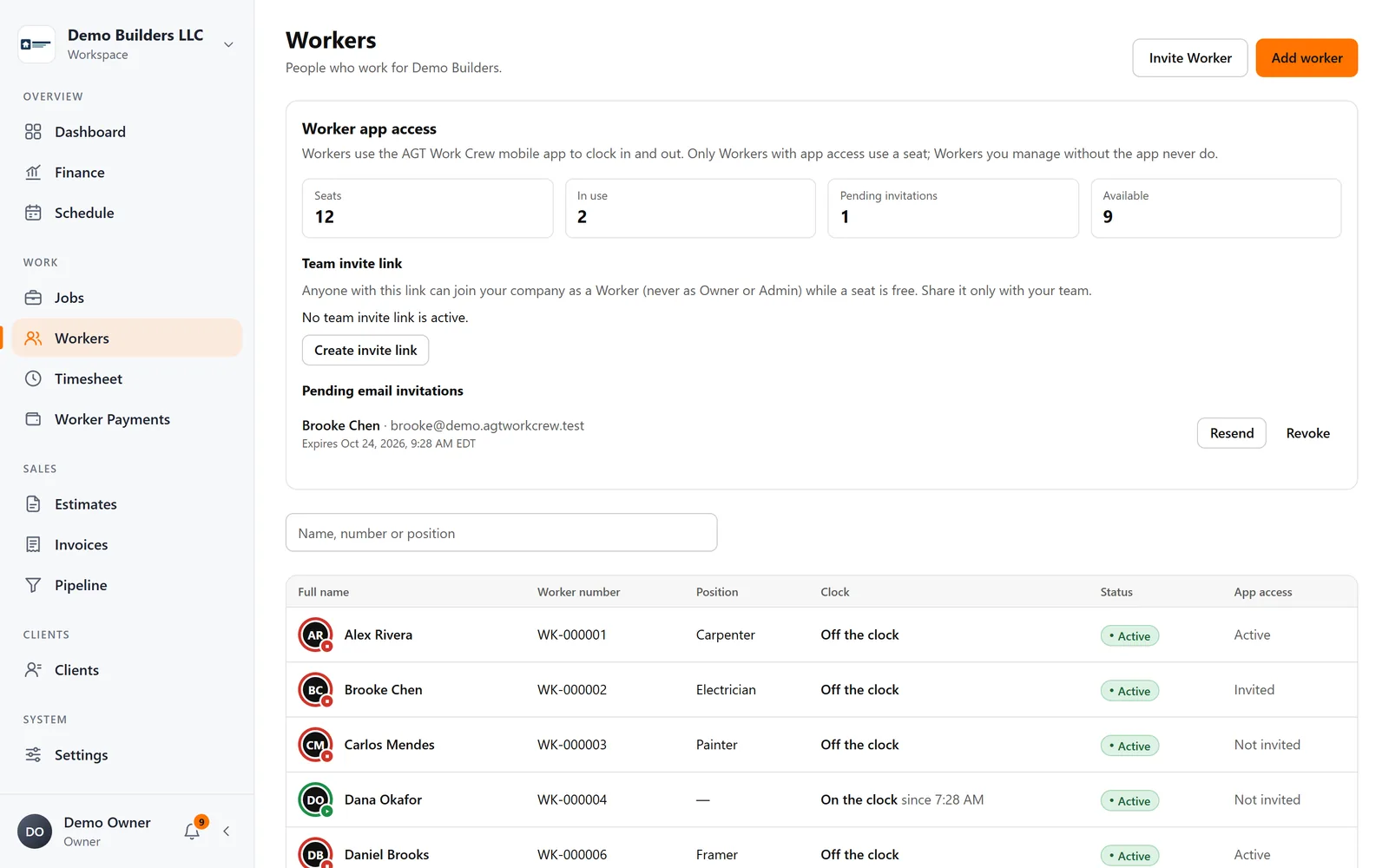
The AGT Work Crew worker app gives every worker the same information, in their own language:
- Invite the crew by email, or share a team link or QR code. Workers join your company in the app.
- The app is available in English, Spanish and Portuguese, and each worker chooses their own language.
- Workers clock in and out, start and end breaks, and see their schedule, their own hours and their payments in one place. The app checks location only at clock events, and works offline when there's no signal.
- Workers send daily reports with photos, so the work done is documented, whatever language it was discussed in.
- Workers see only their own data, nothing else from the office. Someone who works for more than one company uses one login.
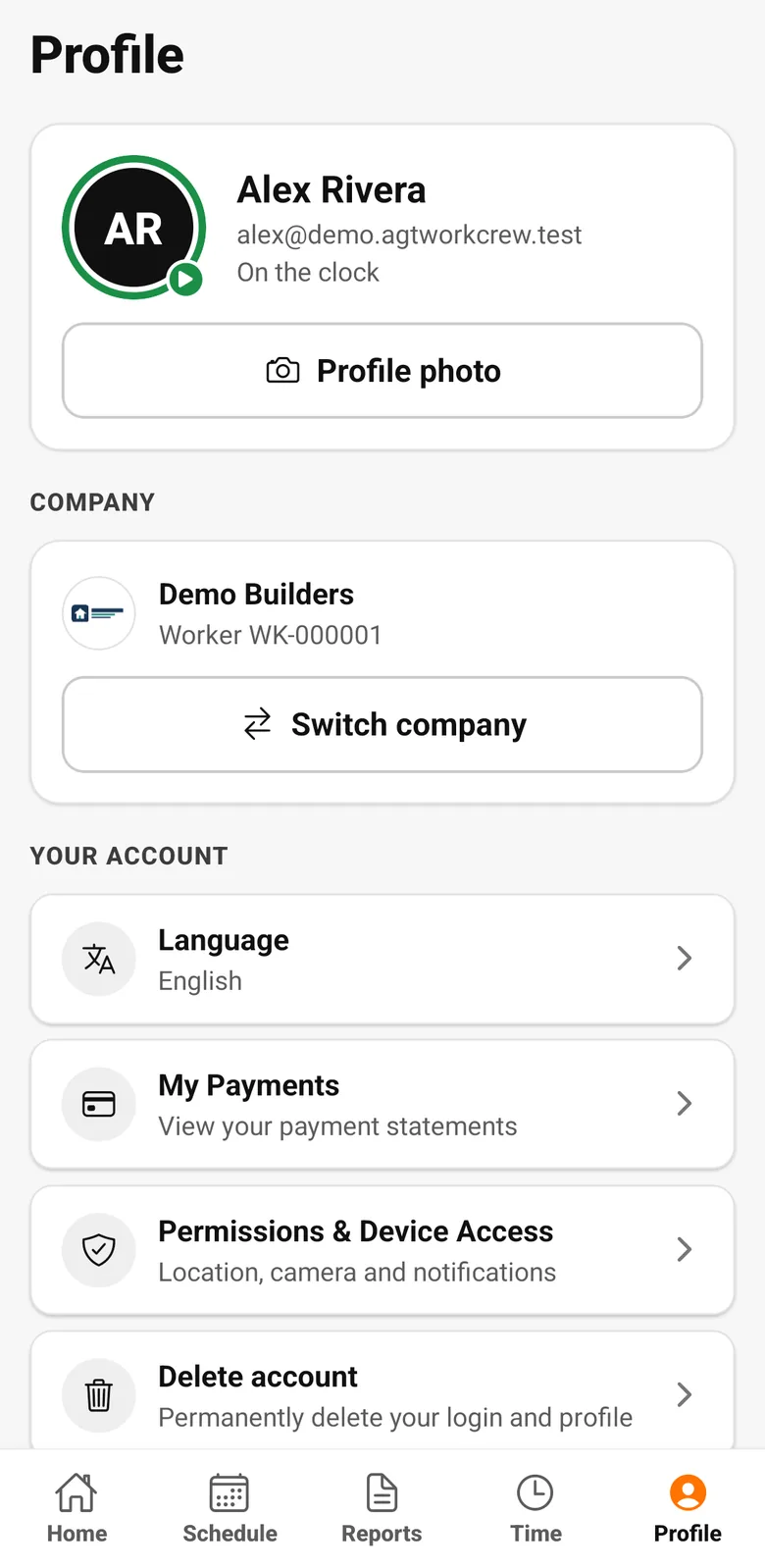
When the whole crew sees the same plan in their own language, the outlets end up on the right wall. See how the worker app works.