The 30-minute weekly review for owners running several jobs
A simple weekly routine for owners: jobs that need attention, margin by job, time cards, overdue invoices, open estimates and next week's schedule.
By AGT Work Crew Team
It's Friday afternoon and you have four jobs going: a kitchen in Newton, a deck in Quincy, a basement in Framingham and a bathroom that starts next week in Worcester. You spent the week on site, on the phone and at the supply house. If someone asked how the business did this week, the honest answer would be "busy." Busy isn't a number.
The problems that hurt most are rarely real surprises. They were visible weeks earlier, in a place nobody had time to look: a job spending faster than it progresses, an invoice nobody followed up, an estimate that went quiet. A short weekly review is how you catch them while they're still small.
This isn't a meeting or a report for anyone else. It's thirty minutes, the same time every week, the same six questions, and one decision for each item.
Set it up so it actually happens
A review that depends on "when I have time" won't happen. A few rules make it stick:
- Pick a fixed slot. Friday after the crew leaves, or Monday before the first site visit. Put it on your calendar like a client meeting.
- Follow the same order every week. You shouldn't have to think about what to look at, only about what you see.
- One decision per item. Not "keep an eye on it." Write who does what, and by when. If nothing needs deciding, move on.
- Keep a short list of decisions. Next week, start by checking whether last week's list got done.
A simple time budget:
- Jobs that need attention: 8 minutes
- Margin by job: 6 minutes
- Open time cards: 4 minutes
- Overdue invoices: 4 minutes
- Estimates waiting for an answer: 4 minutes
- Next week's schedule: 4 minutes
1. Jobs that need attention
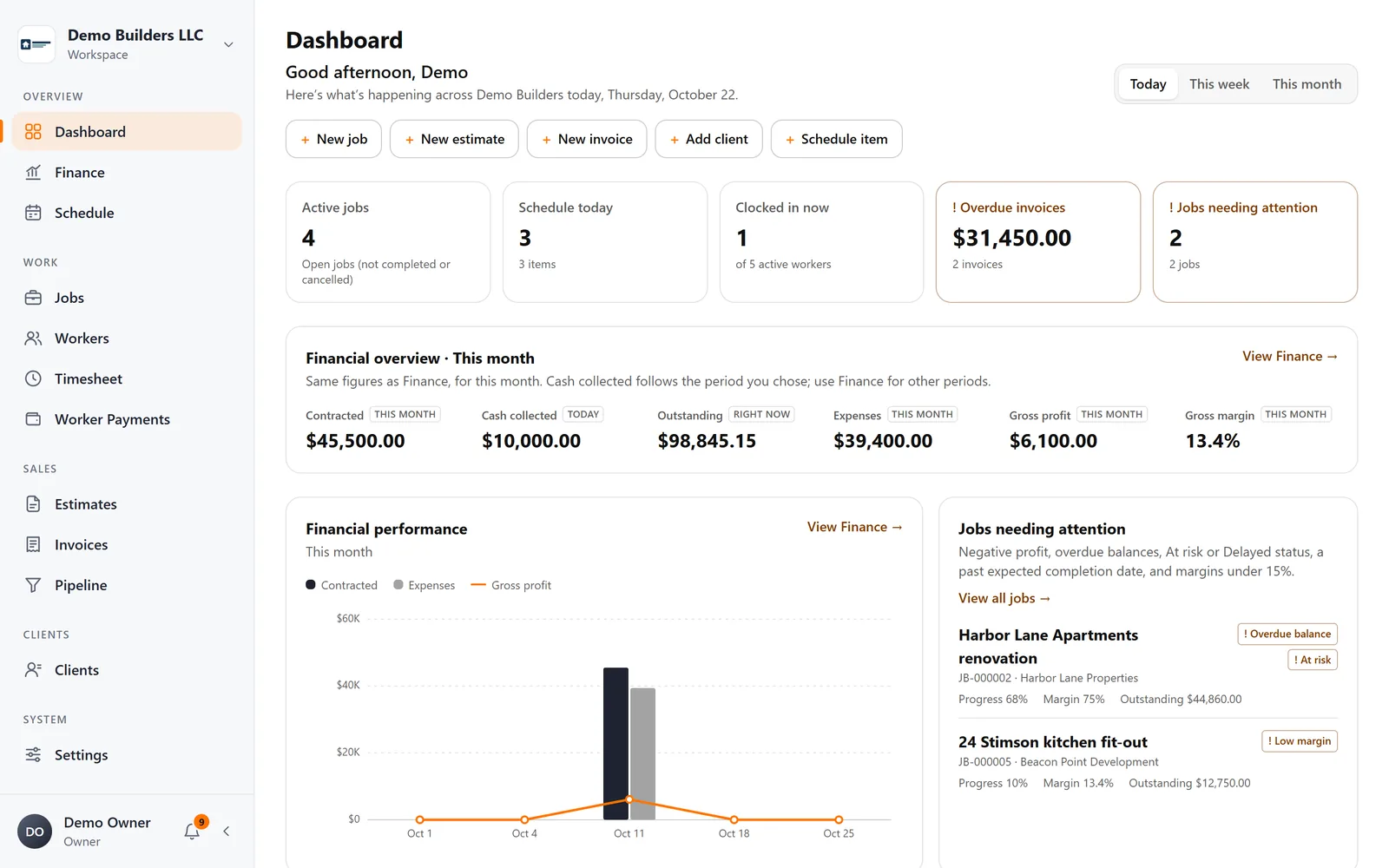
Start with the jobs, because almost everything else connects back to them. For each running job, ask three questions:
- Is progress where it should be? Compare what's done with what you planned for this point.
- Is anything blocked? An inspection, a late delivery, a client who still hasn't picked the tile.
- Is the crew doing work that isn't on an approved change order? That's cost without value.
Typical decisions: "Call the Newton client Monday about the tile," or "Price and send the change order for the extra circuits in Framingham."
2. Margin by job
Look at each job's numbers, not the average. A healthy average can hide one job that's losing money.
For each job, compare the cost ratio (total costs divided by current job value) with real progress. A job that's 40% done with 60% of its value already spent is the earliest warning you'll get. Then rank your jobs by margin and give the bottom one most of these six minutes.
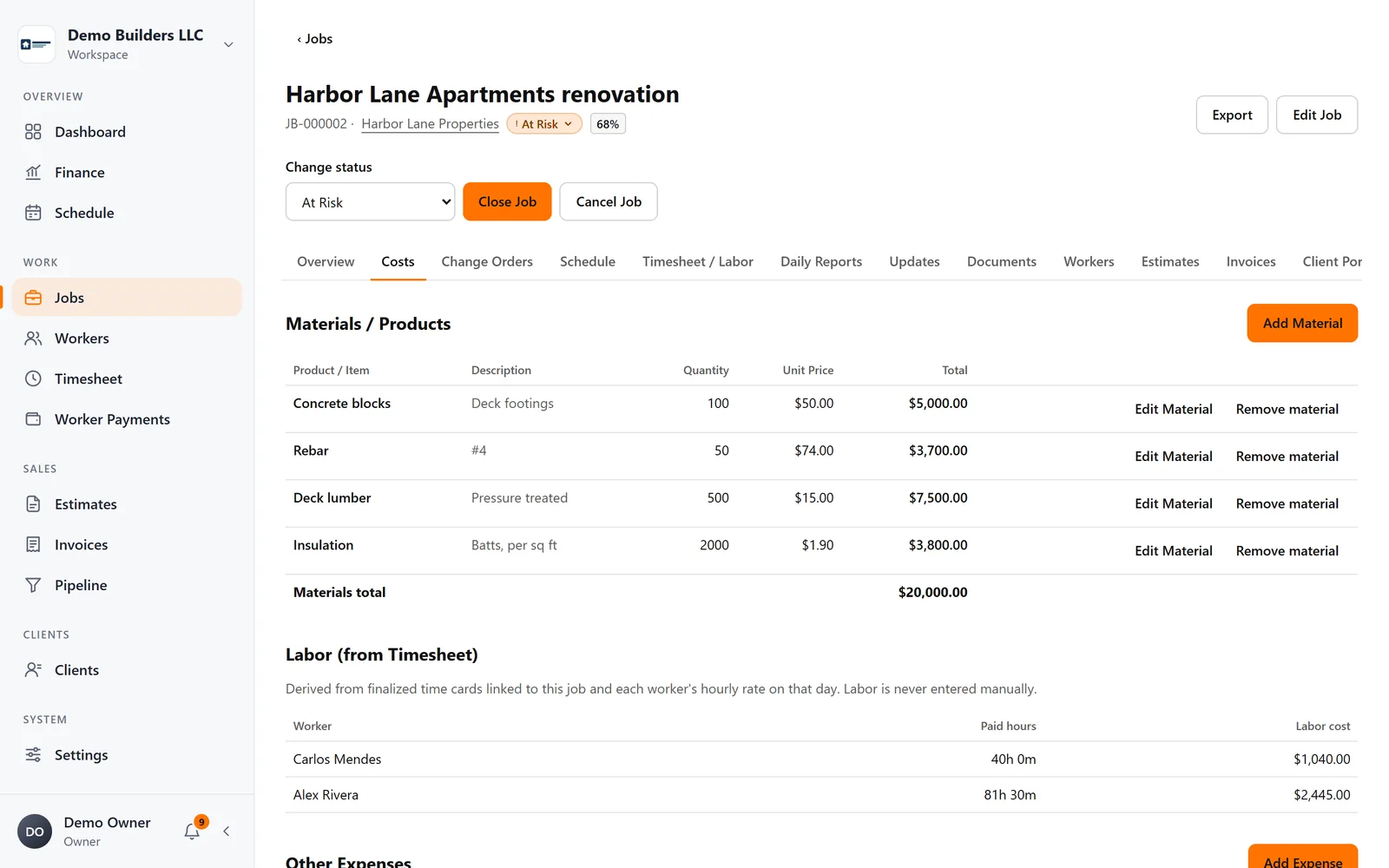
Common causes: labor running ahead of plan, too many small material runs, and extra work nobody priced. Decisions here are concrete: adjust the crew for a few days, send the pending change orders, or talk to the client about scope while there's still room.
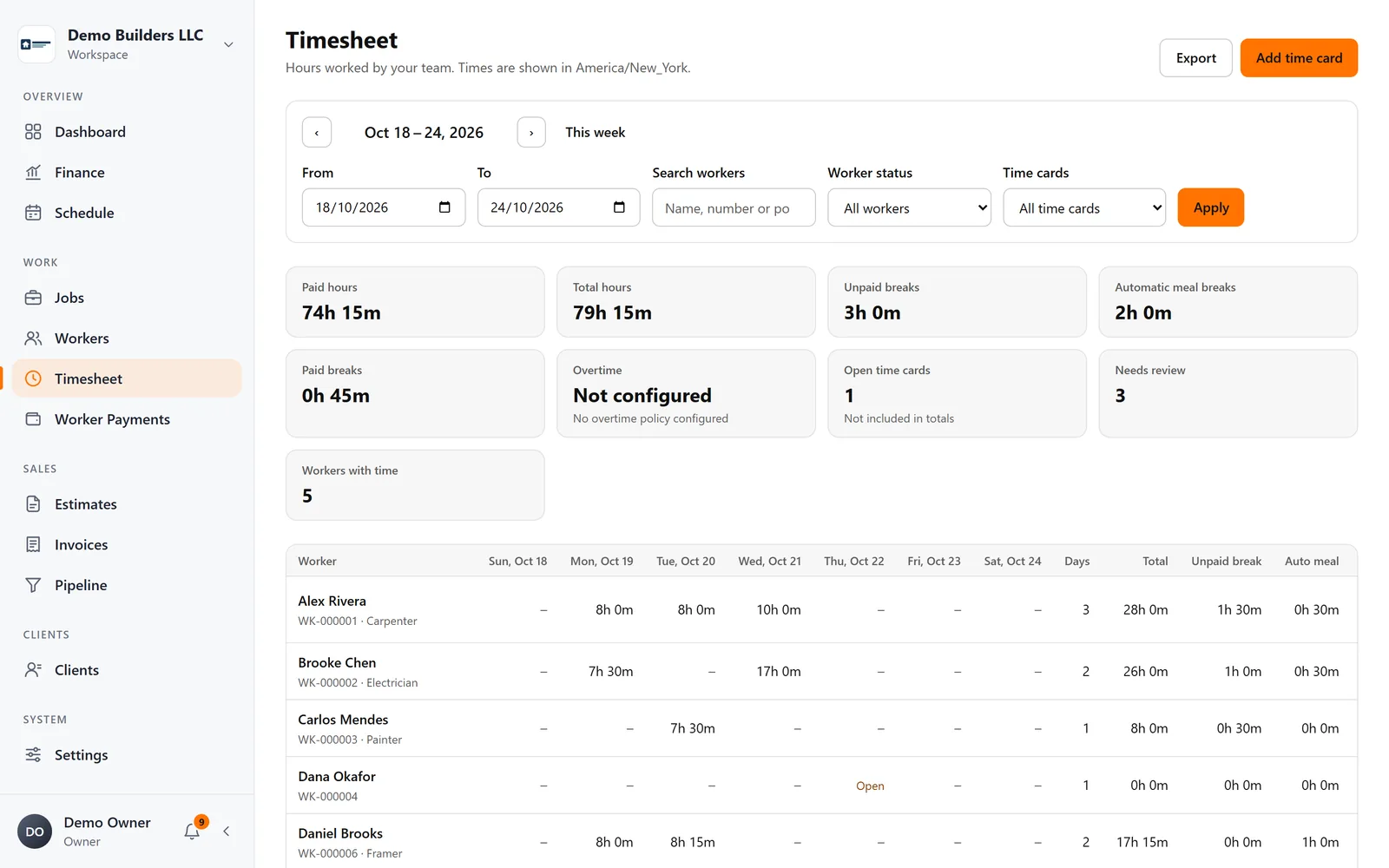
3. Open time cards to fix
Hours feed two things you care about: what each job costs and what you pay your crew. Fix them now, while everyone still remembers the week, not on pay day.
Look for:
- Cards still open because someone forgot to clock out.
- Hours on the wrong job.
- Entries that look off, like a clock-in far from the job site or a shift much longer than usual.
The decision is either "fix it" or "ask the worker one specific question." When you correct a card, write down why.
4. Overdue invoices
Go oldest first, then largest. For each overdue invoice, decide who contacts the client and when. A friendly call when an invoice is a week late is much easier than a hard one at sixty days.
If an invoice is late because the client disagrees about the work, that isn't a collections problem. It's a job problem, so take it back to step one next week.
5. Estimates waiting for an answer
Estimates that sit quietly tend to go cold. For each pending one, ask:
- Did the client open it?
- When did you last talk?
- Is there a question you can answer, or a scope you can adjust?
The decision is follow up, revise, or mark it lost and note why. A clear "no" is more useful than a maybe that sits on your list for two months.
6. Next week's schedule
Look one week ahead, not one day:
- Is every job covered, and is every worker assigned somewhere?
- Are inspections, deliveries and client meetings on the calendar, with the right dates?
- Is there a backup plan for the weather? From November on in New England, exterior work needs an indoor task ready for the cold or wet days.
Confirm any changes with the crew before the weekend, not at 6:30 on Monday morning.
How AGT Work Crew helps
The review is faster when the numbers are already in one place instead of in texts, receipts and a notebook.
- The dashboard shows active jobs, today's schedule, the crew clocked in, overdue invoices and jobs that need attention, so step one starts from a list instead of from memory.
- Every job keeps its contract value plus approved change orders, materials, other expenses and labor from tracked hours, with profit, margin and cost ratio kept up to date.
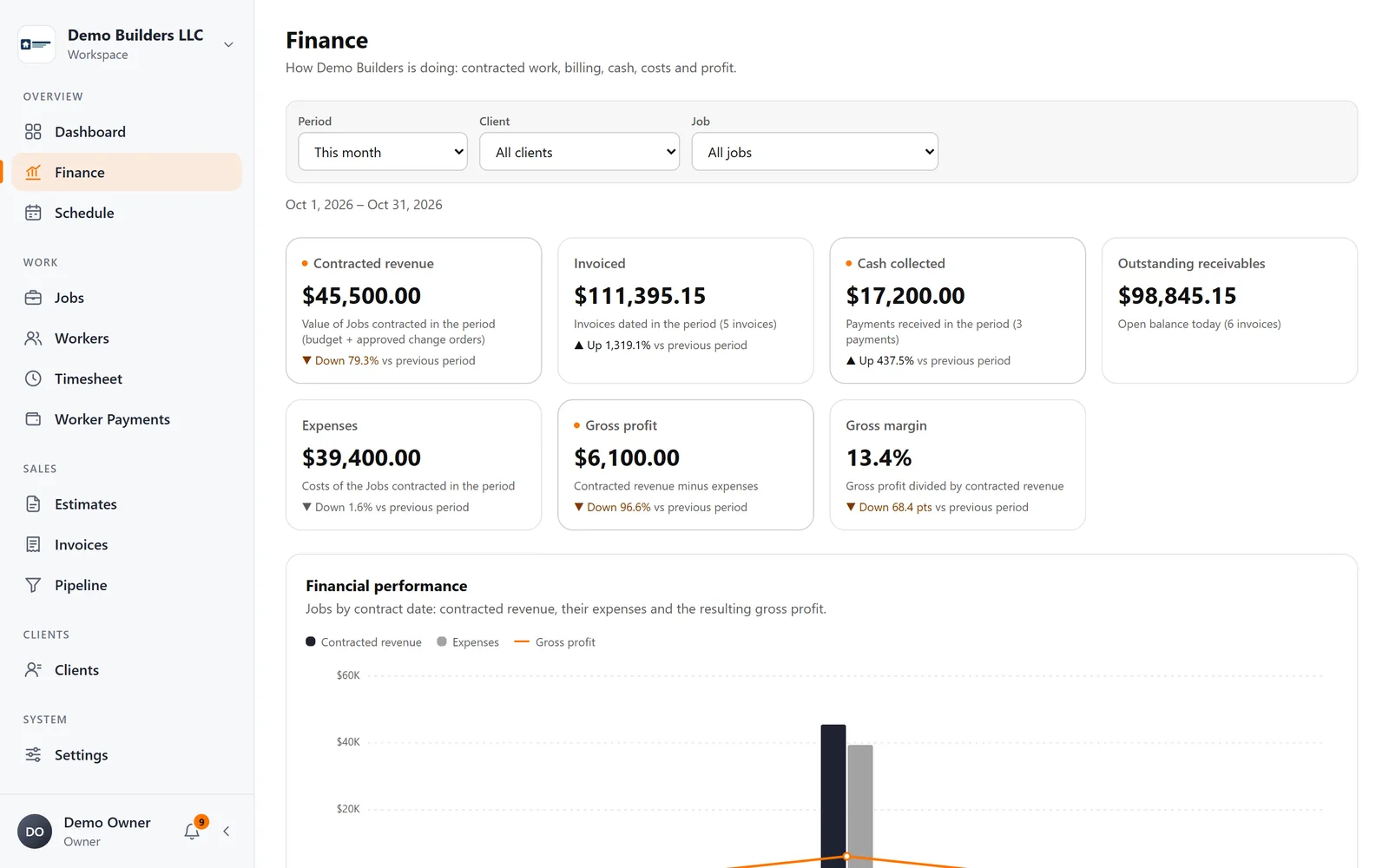
- The finance dashboard adds a job profitability ranking, invoice status and receivables aging, so you know which job and which invoice to look at first.
- Timesheets flag entries outside the job-site radius or without location for review, and every correction keeps the original in the history with a reason.
- Estimates show which ones are still pending, and you can see when a client opens one.
- The schedule has month and list views with worker assignments, and workers see their schedule in the app.
Thirty minutes a week, with the right numbers in front of you, is how you stay ahead of several jobs at once. See jobs and profitability in AGT Work Crew.