Cash flow basics for small contractors: why busy can still mean broke
Contracted, collected and outstanding, why profitable jobs still leave you short, deposits and progress billing, and a 15-minute weekly money check.
By AGT Work Crew Team
You just signed a big addition in Needham and two kitchens are underway in Somerville. On paper it's your best season yet. Then Thursday comes, payroll for the crew is due, the cabinet supplier wants a deposit for the next job, and the business account is thinner than it's been all year. How can you be this busy and this short at the same time?
That gap has a name: cash flow. Profit tells you whether a job is worth doing. Cash flow tells you whether you can keep the doors open while you do it.
Three numbers every contractor should know
Most small contractors watch one number: the bank balance. It's real, but it only tells you about today. Three other numbers tell you where you actually stand:
- Contracted: the work you've sold and agreed on, including approved change orders. This is what your jobs are worth.
- Collected: the money that has actually arrived. Not invoiced, not promised: in the account.
- Outstanding: what you've invoiced and clients still owe you. This is money you've earned but can't spend yet.
Here's an example to make it concrete. Say you have $180,000 contracted this quarter, $95,000 collected and $40,000 outstanding. The rest hasn't even been billed yet. If you only look at the first number, you feel rich. If you only look at the bank, you feel broke. You need all three to see the truth.
Why profitable jobs can still leave you short
A job can make good money and still put you in a hole for weeks. The reason is timing:
- You pay first. Materials, dumpsters, permits and the crew are paid as the work happens, often weekly.
- The client pays later. Even a good client pays after the invoice, and the invoice goes out after a milestone.
- Big jobs make the gap bigger. The larger the project, the more you spend before the next payment arrives.
- Several jobs at once multiply it. Three jobs in the same stretch of heavy spending can drain the account even if all three are profitable.
Growth makes it worse, not better. Taking on more work means paying for more materials and labor up front. Plenty of contractors around Boston have learned this the hard way during a busy spring, right before the money from the winter jobs came in.
Time your billing to the money going out
You can't avoid paying first, but you can shrink the gap. These are business habits, not rules, and they work best when they're agreed on before the job starts:
- Ask for a deposit before you order. It helps cover the first materials and shows the client is committed. Many contractors size it to cover the first big purchase.
- Bill in stages, not at the end. Break larger jobs into progress payments tied to clear milestones: demo and framing, rough-in, cabinets and finishes, final walkthrough.
- Put the expensive stages early in the schedule of payments. If the windows or the custom cabinets are the biggest bill, try to have a payment due before or right after you pay for them.
- Invoice the day the milestone is reached. Every day you wait to send an invoice is a day added to the gap.
- Bill approved change orders on the next invoice. Don't let extras pile up until the end of the job.
Collect the oldest balances first
When several invoices are open, it's tempting to chase the biggest one or the client you talk to most. Start with the oldest instead. The longer a balance waits, the harder it gets to collect: the work is no longer fresh in the client's mind, and other bills have moved ahead of yours.
A simple way to see it is to group open invoices by how late they are: not yet due, a little late, very late. Work from the late end. Keep every reminder short and polite, and always say exactly which invoice and what amount you're asking about.
Partial payments count. If a client pays half now and half in two weeks, record what came in, update the balance and set the next follow-up. A partial payment you track is better than a full payment you keep waiting for.
A weekly money check in fifteen minutes
Pick the same time every week, say Monday morning before the trucks roll out, and answer five questions:
- What came in last week? Compare it with the week before.
- What's outstanding, and what's overdue? Who do you need to call today?
- What's going out in the next two weeks? Crew, materials, subs, equipment.
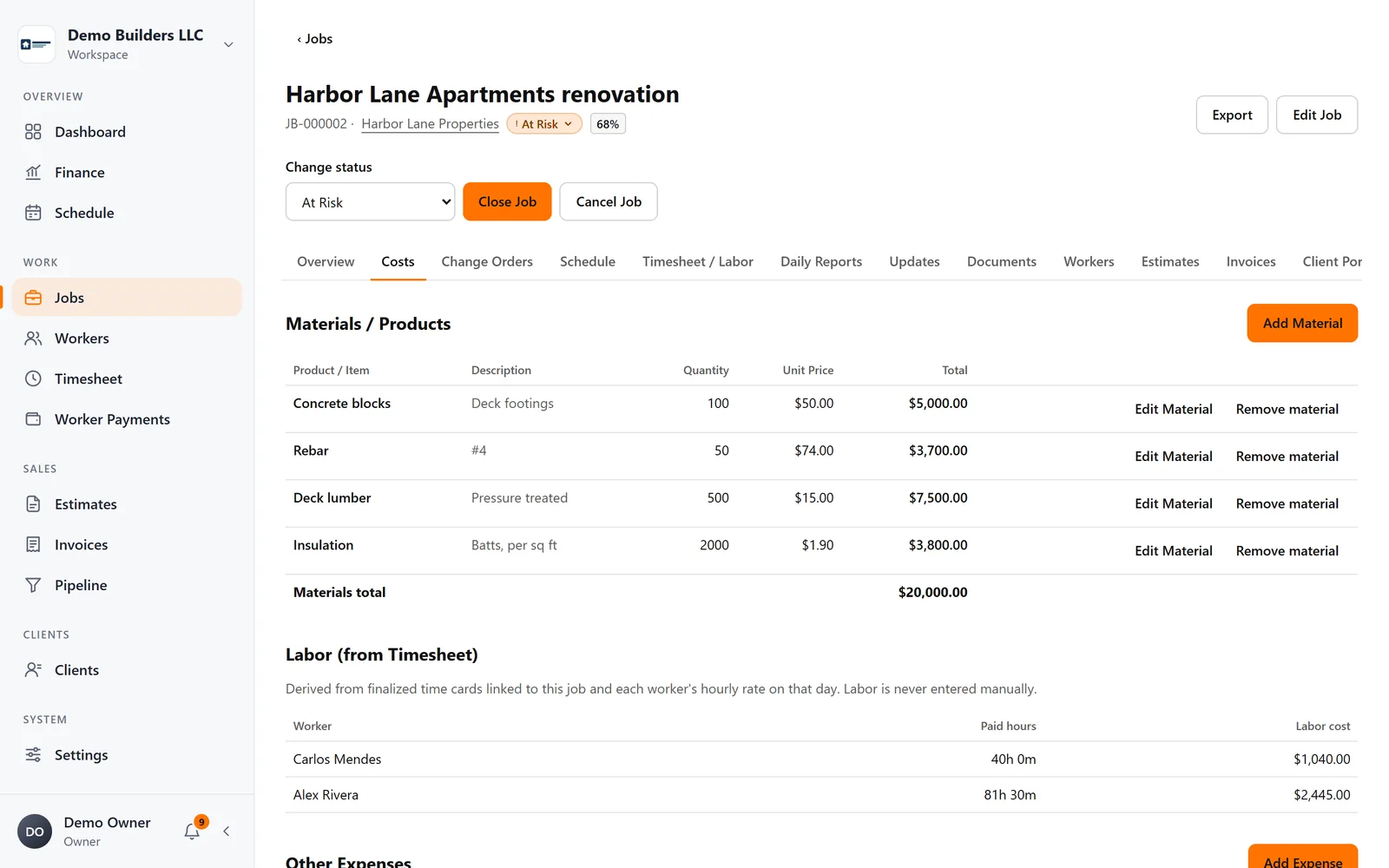
- Which jobs are using more money than they should? Compare each job's expenses with what you planned.
- What can you bill this week? Any milestone reached, any change order approved.
If the numbers coming in don't cover what's going out, you want to know on Monday, not on Thursday.
Fifteen minutes a week won't make a slow January in New England disappear, but it means you'll see it coming and plan for it.
How AGT Work Crew helps
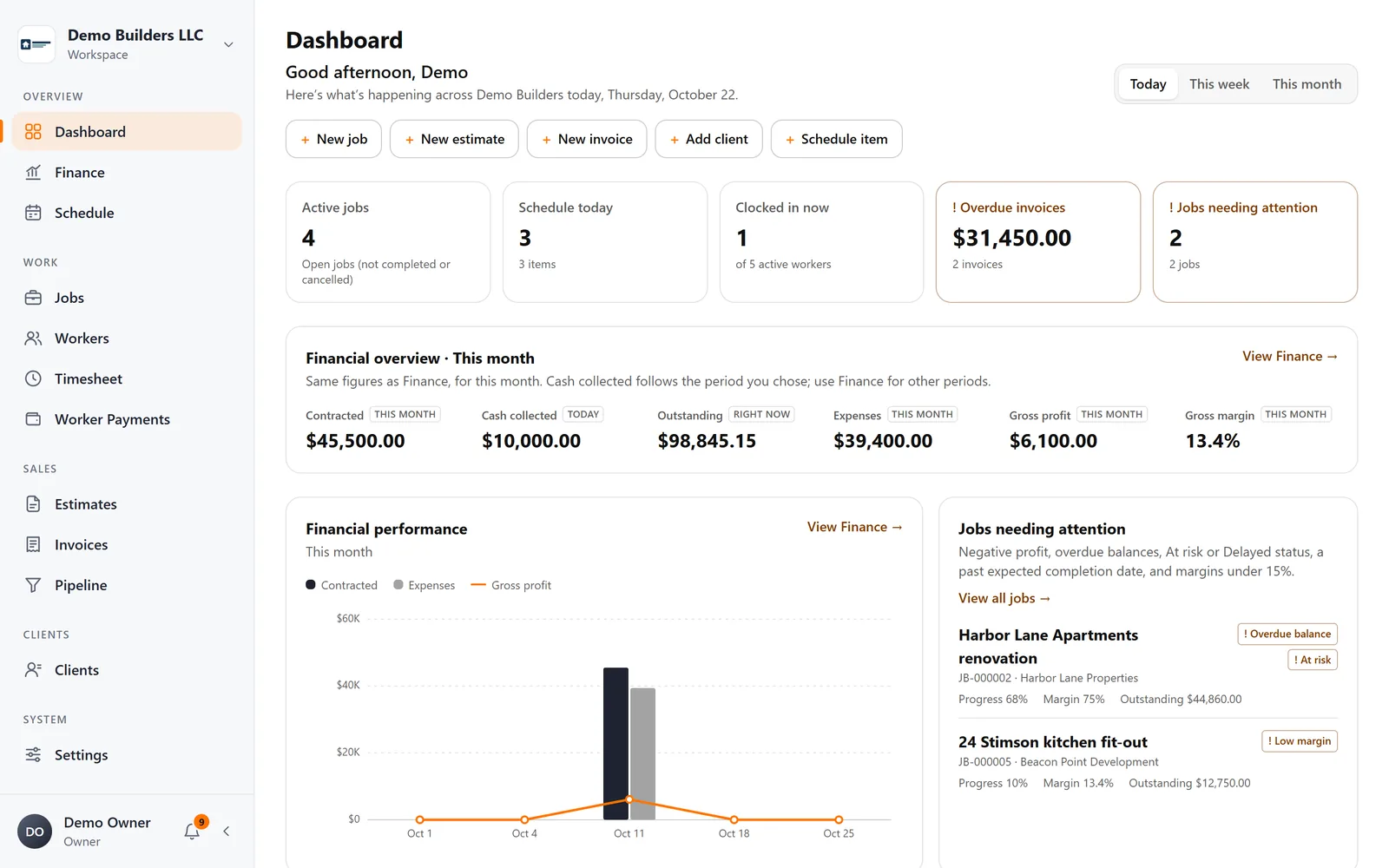
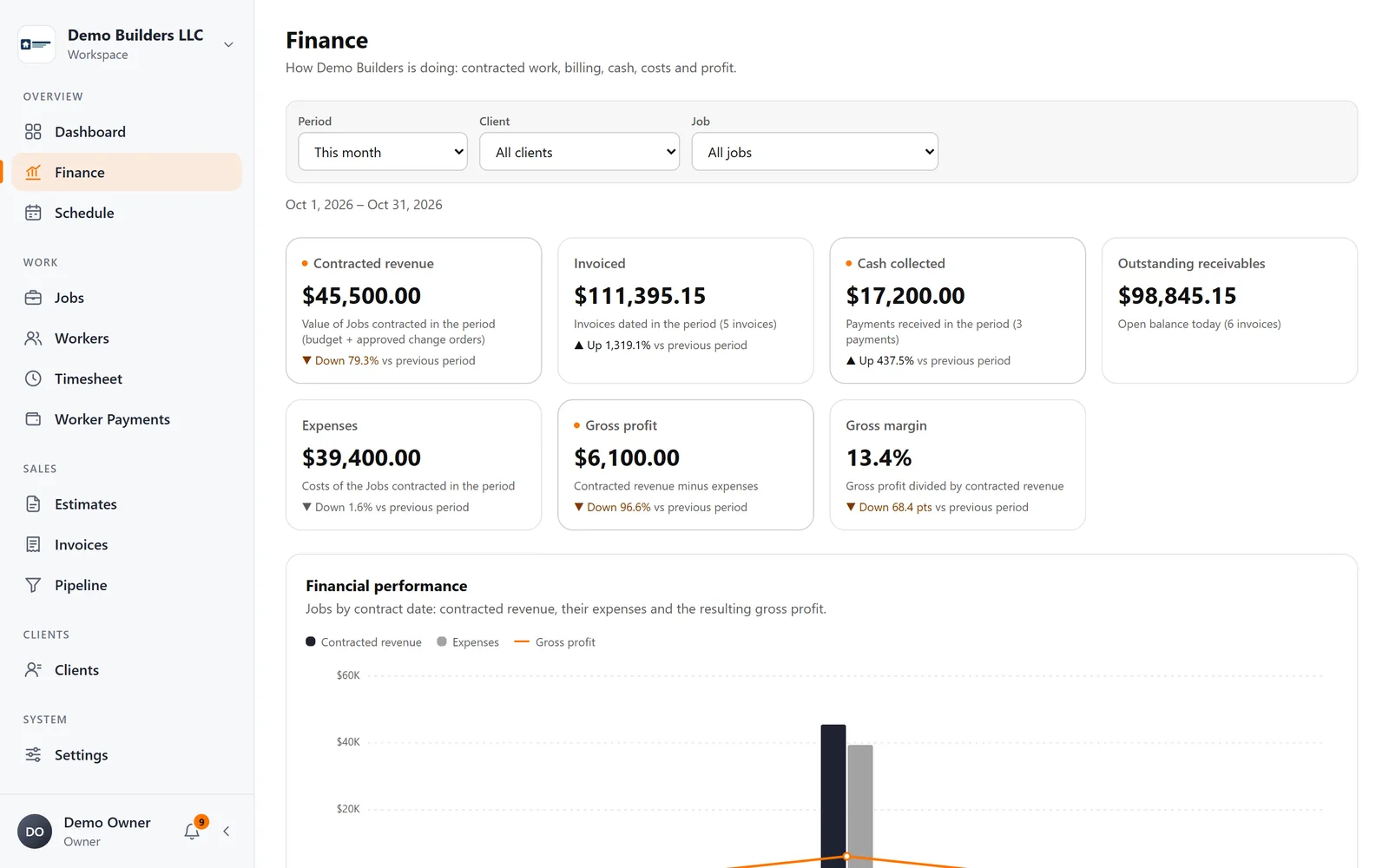
The Finance dashboard in AGT Work Crew puts these numbers in one place:
- Contracted, collected and outstanding, plus expenses, gross profit and margin, for the period you choose.
- A comparison with the previous period, so you can see if things are getting better or worse.
- Revenue, cash and expense charts to see the trend at a glance.
- Invoice status and receivables aging, so you know which balances are oldest and what to collect first.
- A job profitability ranking that shows which jobs make money and which need attention.
The figures come from your own jobs, invoices and recorded payments. Every invoice has a due date, invoices that pass it show as overdue, and you record partial and full payments as they come in, so the balance is always current.
When you know what's contracted, collected and still owed, busy seasons stop feeling like a cash crunch. See the Finance dashboard.