“How’s it going?” Keeping homeowners updated without the phone calls
Stop the “how’s it going?” calls: set expectations at kickoff, send regular updates with photos, share the right things and deliver bad news early.
By AGT Work Crew Team
It's 7:40 on a Tuesday night. You've just sat down after a day on a gut renovation in Medford, and your phone lights up: "Hi! Just checking in, how's it going? Are we still on track?" It's the third text from the same homeowner this week. Nothing is wrong. They just don't know what's happening inside their own house, so they ask. Multiply that by every open job and you have a second, unpaid job: answering the phone.
The fix isn't to answer faster. It's to give homeowners the answer before they need to ask.
Why homeowners keep calling
Most "how's it going?" calls aren't about distrust. They come from three simple gaps:
- They can't see the work. They're at the office all day, or living with family while the kitchen is torn out.
- They don't know what "normal" looks like. Two days of nothing visible while the plumber waits on an inspection feels like the job has stalled.
- They're spending a lot of money. A bathroom in Brookline or an addition in Needham is often the biggest check they'll write all year. Silence makes people nervous.
Close those gaps and most of the calls stop on their own.
1. Set expectations at kickoff
The first conversation shapes every one after it. Before demolition starts, tell the homeowner, plainly:
- How you'll update them and how often. "Every Friday afternoon you'll get an update with photos" is a promise you can keep.
- Who to contact for what. Day-to-day questions go to one person, not to whoever is on site.
- What a normal week looks like. Explain the quiet stretches in advance: waiting on inspections, drying time for mud and tile, cabinets on order.
- How changes work. Anything outside the scope becomes a change order, approved in writing before the work is done.
Homeowners who know the plan worry less when nothing looks different from the driveway.
2. Pick a rhythm and stick to it
A regular update beats a dozen random texts. Weekly works for most remodels; a short daily note can make sense during demolition or on a fast job. What matters is consistency: if the update always arrives on Friday, nobody calls on Thursday to ask.
A good update answers three questions in a few lines:
- What got done since the last update.
- What's next, and roughly when.
- Anything we need from you: a tile choice, access to the basement, a decision on a fixture.
Keep it short. A homeowner reads three clear lines; they skim three paragraphs.
3. Let photos do the talking
On a remodel, a photo explains more than a paragraph. A few habits make photos useful instead of noise:
- Shoot the same angle each time, so progress is obvious at a glance.
- Photograph what will be hidden. New wiring in an old Somerville triple-decker, blocking for a vanity, the waterproofing behind the shower tile. Once the walls close, the photo is the only proof.
- Add a one-line caption. "Subfloor replaced under the tub, old joist sistered" turns a blurry picture into reassurance.
4. Share progress, keep the business internal
Being open doesn't mean showing everything. A homeowner wants to see progress, decisions and what's coming next. They don't need your material costs, your margins, which worker was late or an internal note about a sub you're unhappy with.
Decide up front what goes to the client and what stays with your team, and keep the two clearly separate. One forwarded email with the wrong attachment can undo months of goodwill.
5. Deliver bad news early
Old New England houses hide surprises: rot behind the clapboards, knob-and-tube wiring, a sill that a century of nor'easters has worn soft. When you find one, tell the homeowner the same day, with:
- What you found, with a photo.
- What it means for cost and schedule.
- The options, and your recommendation.
Bad news delivered early is a problem you solve together. Bad news discovered late is a broken promise.
Homeowners forgive surprises. They rarely forgive hearing about them last.
How AGT Work Crew helps
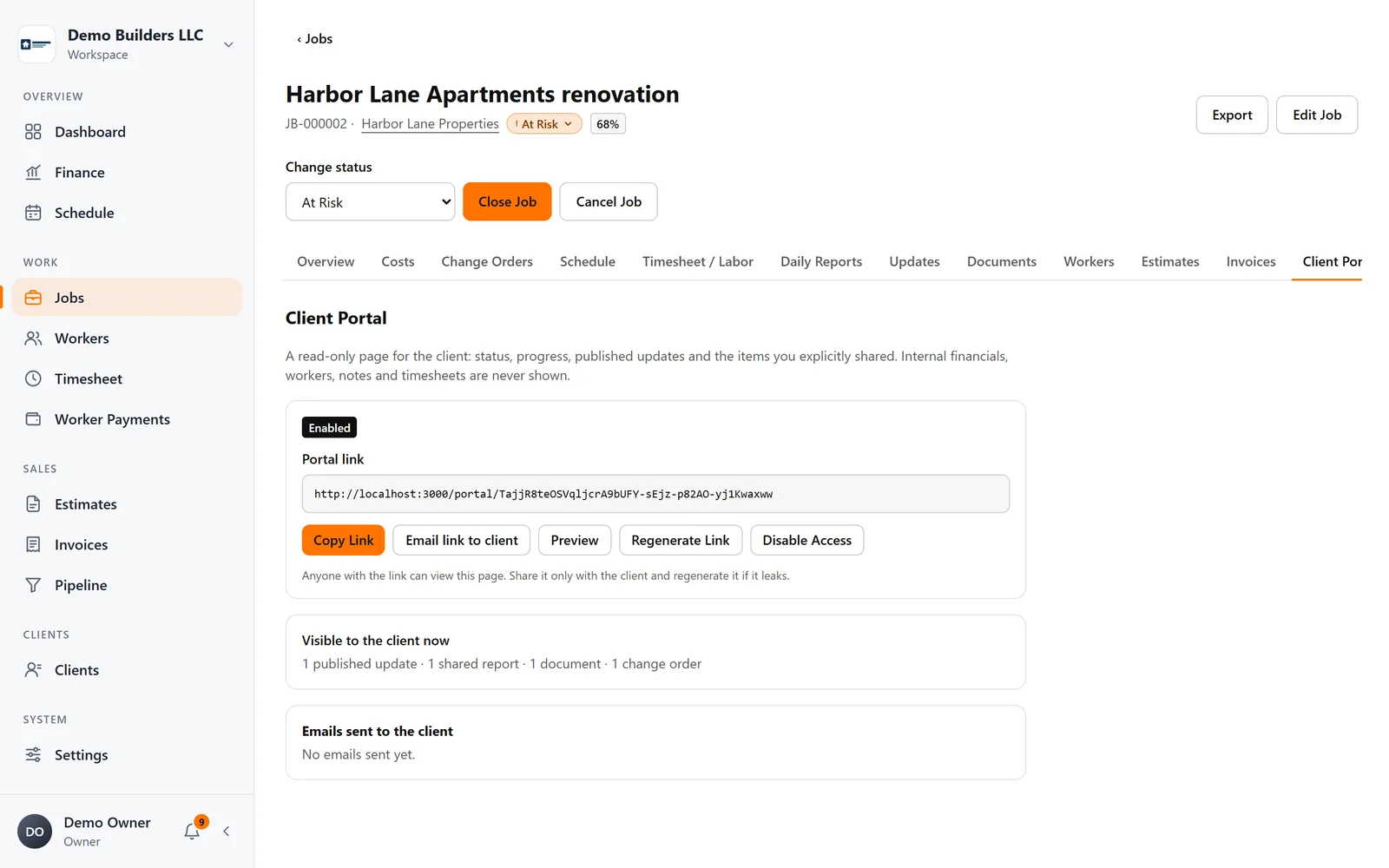
The Client Portal gives each job a secure project page your client opens from any device, with no account and no password.
- You turn the portal on for a job and email the link to the client as your company, or copy it.
- The client sees project progress, the updates you publish, the daily reports and photos you share, approved change orders and the documents you mark as visible.
- Internal costs, workers and notes are never shown. You decide what the client sees.
- Your crew writes daily reports with photos and captions in the app, even offline. Reports stay private until you share one, or turn it into a client update.
- You can regenerate or disable the link at any time.
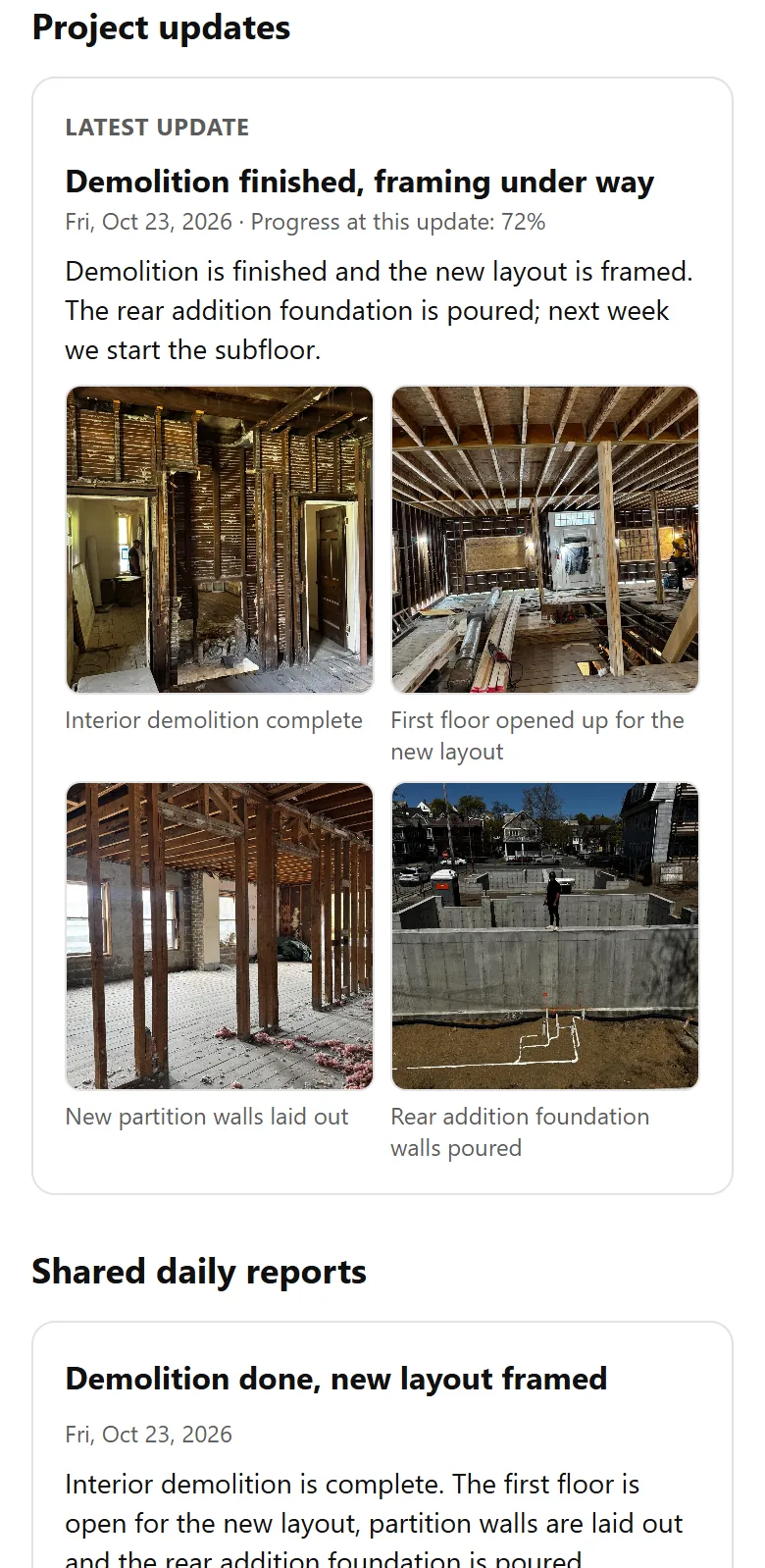
When homeowners can see the work, they stop needing to ask about it. See how the Client Portal works.